
Long-Term Capital Management: History, the Crash, and the Associated Risks
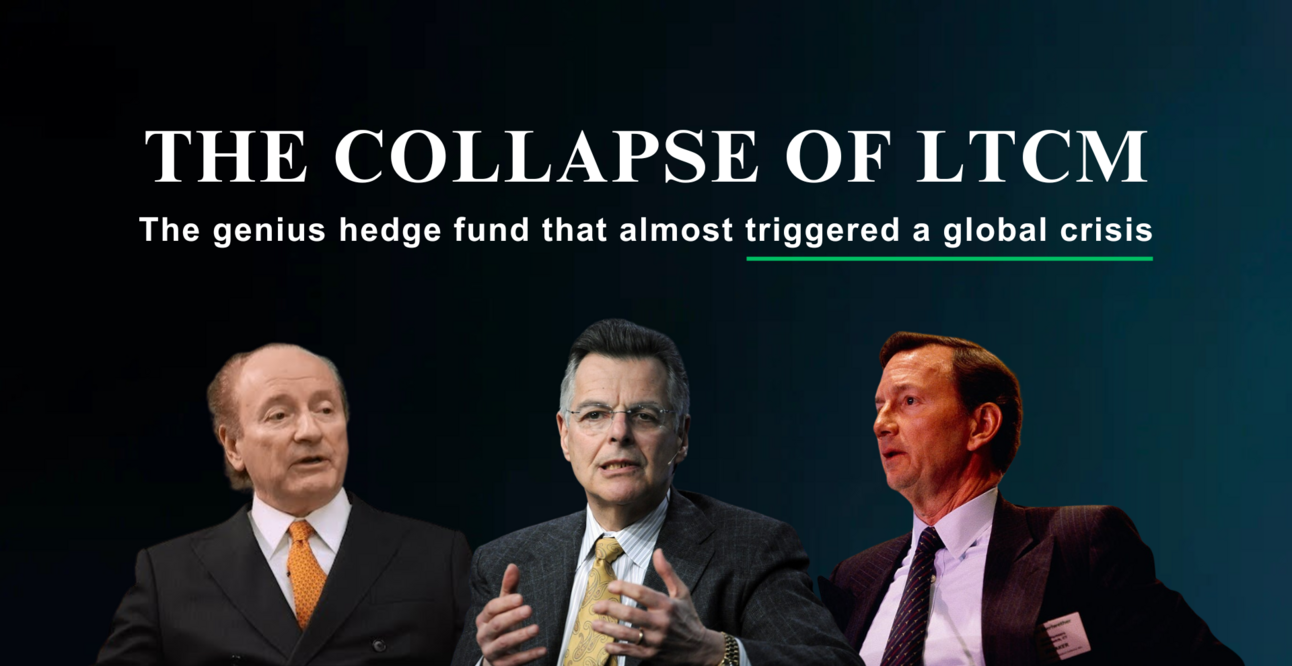
Long-Term Capital Management (LTCM) was one of the most notorious and controversial hedge funds in financial history. Founded in 1994 by a group of prominent traders and academics, including Nobel laureates Myron Scholes and Robert Merton, LTCM stood out for its sophisticated arbitrage strategies and extensive use of leverage. However, in 1998, the fund suffered a spectacular collapse that threatened the stability of global markets, requiring a bailout by a consortium of banks. This episode remains a prime example of the risks associated with high-yield investing and inadequate risk management.
In this article, we explore LTCM's history, the causes of its collapse, and the associated risks, highlighting lessons learned for the contemporary financial world.
The Birth and Strategy of LTCM
LTCM was founded by John Meriwether, former head of fixed income trading at Salomon Brothers, along with a team of quantitative finance experts. The fund focused on convergent arbitrage strategies, exploiting small price discrepancies in similar financial assets, such as government bonds, swaps, and derivatives. Using advanced mathematical models based on Black-Scholes theory, LTCM aimed to generate high returns with seemingly low risk.
At its peak in 1997, LTCM managed approximately $4.7 billion of equity capital, but thanks to extreme leverage (up to 30:1 or more), the notional value of its positions reached over $1 trillion. Initial returns were impressive, exceeding 40% annually in the early years, attracting institutional investors and investment banks.
However, this strategy relied on key assumptions: efficient markets, constant liquidity, and historical correlations between assets. Assumptions that proved fragile in the face of unforeseen events.
The Crash of 1998
The summer of 1998 marked the beginning of the end for LTCM. It all began with the Russian financial crisis: the default on Russian sovereign debt and the devaluation of the ruble caused a wave of global panic. Bond markets, which LTCM considered "safe," went into turbulence. Investors fled to safer assets, such as US Treasuries, widening spreads that LTCM had bet would narrow.
In just a few weeks, LTCM lost billions. By the end of August, the fund had lost 44% of its value, and by September, losses exceeded 90%. Leverage amplified the losses: positions requiring additional margin led to forced sales, worsening market liquidity. The fund nearly collapsed, threatening a domino effect on banks exposed to hundreds of billions.
To avert systemic disaster, the Federal Reserve orchestrated a private bailout: 14 banks invested $3.6 billion in exchange for 90% of the fund, allowing for an orderly liquidation. LTCM was closed in 2000, with total losses estimated at $4.6 billion for the original investors.
The Related Risks
The LTCM case highlights several risks inherent in hedge funds and modern finance:
Excessive Leverage Risk: LTCM operated with extremely high leverage, turning small losses into catastrophes. Leverage amplifies gains, but also losses, making the fund vulnerable to market shocks.
Liquidity Risk: Arbitrage strategies assumed liquid markets, but in a crisis, liquidity evaporates. LTCM could not sell assets without further losses, triggering a vicious cycle.
Quantitative Model Risk: LTCM's models were based on historical data, ignoring "black swans" like the Russian crisis. Extreme events not forecast by the models led to an underestimation of risk.
Systemic Risk: LTCM was "too big to fail." Its collapse could have spread to global banks, highlighting interconnections in the financial system.
Poor Management Risk: Despite its expertise, LTCM underestimated correlations between stressed markets. It lacked robust stress tests for extreme scenarios.
These risks are not isolated: they amplify each other, as seen in subsequent crises such as 2008.
Lessons Learned and Current Implications
The collapse of LTCM prompted regulatory reforms, such as greater transparency for hedge funds and an emphasis on risk management. It influenced the Dodd-Frank Act and the Basel rules, emphasizing stress tests and leverage limits.
Today, with the rise of quantitative funds and cryptocurrencies, the lessons of LTCM remain relevant. Investors and regulators must be vigilant about excessive leverage and models that ignore geopolitical uncertainties. As Warren Buffett said, "Only when the tide goes out do you find out who was swimming naked."
In conclusion, LTCM serves as a cautionary tale: financial innovation brings opportunity, but without prudent risk management, it can lead to systemic disaster. Studying this case helps navigate today's complex markets.
Thank you for reading. Share this article with your network!