
Lehman Brothers: Origins, History, and Decline
Lehman Brothers was one of the most influential American financial institutions, a symbol of Wall Street capitalism. Founded in the 19th century as a simple general merchandise store, it evolved into one of the world's largest investment banks. Its history reflects the evolution of the US economy, from its origins in the cotton trade during the slavery era, through the economic crises of the 20th century, to the dramatic collapse in 2008, which triggered the Great Global Financial Crisis. This article explores the origins, historicity, and decline of Lehman Brothers, drawing on reliable historical sources.
Origins
Lehman Brothers traces its roots to 1844, when Henry Lehman, a German-Jewish immigrant from Rimpar, Bavaria, settled in Montgomery, Alabama, and opened a general merchandise store specializing in dry goods. In 1847 and 1850, his brothers Emanuel and Mayer joined him, transforming the business into "Lehman Brothers." Initially, the company focused on the cotton trade, accepting raw cotton from Southern slave plantations as payment for goods. This connection to the slave economy marked the early stages of the company, which expanded into commodities trading during the antebellum period.
In 1855, Henry died of yellow fever, but Emanuel and Mayer continued the business. In 1858, they opened a branch in New York City, gradually shifting their focus to trading in cotton and other commodities. The American Civil War (1861–1865) devastated the Southern economy, but Lehman Brothers survived, contributing to the postwar reconstruction of Alabama and founding the New York Cotton Exchange in 1870.
History and Growth
From the 1870s, Lehman Brothers began to diversify. In 1887, it became a member of the New York Stock Exchange, and in 1899, it issued its first public offering for the International Steam Pump Company, marking its entry into investment banking. Under the leadership of Philip Lehman (1901–1925), the firm partnered with Goldman Sachs on IPOs for companies such as Sears, Roebuck, and F.W. Woolworth.
Robert "Bobbie" Lehman, Philip's son, assumed leadership in 1925 and guided the firm through the Great Depression (1929–1933), focusing on venture capital and surviving the stock market crash. In the 1930s, Lehman financed companies such as RCA and Halliburton, and in the 1950s, he managed the IPO of Digital Equipment Corporation. Until 1969, the firm remained under family control; the death of Robert Lehman marked the end of this era.
In the 1970s, under Pete Peterson (1973–1983), Lehman acquired Abraham & Co. and merged with Kuhn, Loeb & Co. in 1977, becoming the fourth-largest investment bank in the US. Internal conflicts led to its acquisition by Shearson/American Express in 1984 for $360 million. In 1994, it was spun off via an IPO, with Richard Fuld as CEO. The repeal of the Glass-Steagall Act in 1999 allowed for aggressive expansion, including the acquisition of subprime mortgage lenders such as Aurora Loan Services and BNC Mortgage in 2000–2003.
By 2007, Lehman had assets of $639 billion, 26,200 employees, and record net income of over $4 billion. It survived the September 11, 2001, attacks, moving its headquarters to Midtown Manhattan.
Decline and Bankruptcy
Lehman Brothers' decline was precipitated by the subprime mortgage crisis. From 2003, the firm invested heavily in mortgage-backed securities (MBS), many based on high-risk subprime loans, driven by US government policies to promote housing affordability. When home prices began to decline in 2006, defaults increased, eroding the value of mortgage-backed securities (MBS).
In 2007, Lehman closed BNC Mortgage, posting losses. In 2008, following the near-bankruptcy of Bear Stearns, Lehman shares plunged 50%. Quarterly losses reached $2.8 billion in the second quarter and $3.9 billion in the third. Accounting techniques such as "repo 105" were used to hide $50 billion in toxic assets. Rescue attempts with Bank of America and Barclays failed, and the US government refused a bailout, unlike other institutions.
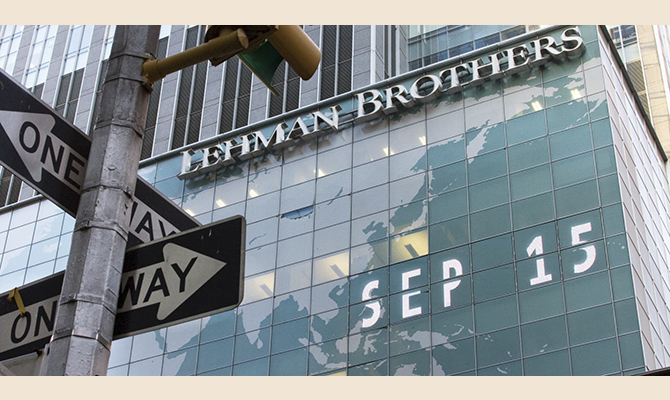
On September 15, 2008, Lehman filed for Chapter 11 bankruptcy, the largest in US history, with debts of $613 billion and assets of $639 billion. This event triggered a global panic, with stock market declines and the Great Recession. Barclays acquired the North American operations, Nomura the Asian and European ones, and Neuberger Berman was sold.
Consequences and Lessons
Lehman's failure accelerated the 2008-2009 financial crisis, leading to reforms such as the Dodd-Frank Act. It symbolizes the risks of excessive leverage and real estate speculation. Today, the Lehman name lives on in entities such as Neuberger Berman, but the lesson remains: no institution is "too big to fail" without systemic consequences.
Thank you for reading. Share this article with your network!